 |
|||||||
|






|
|
 |
|
|
|
|
|
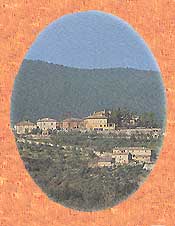
The agricultural estate of Montestigliano has been owned and farmed by the Donati family for over fifty years. Centrally located in the heart of Tuscany, perched high on a hill, at an altitude of approximately 300 meters, Montestigliano commands magnificent views of the Sienese landscape. To the north one can see the towers and the duamo of Siena in the distance, to the east the Crete Senese and the Chianti hills, and the wooded Montagnola to the West. In the Middle Ages, Siena was one of the most prominent and important business and banking centers in Europe. The area was also rich in water, something now very precious as sadly, with the increased local population, today water is quite scarce. However in earlier years water contributed to creating a great productive center for textiles, iron and metal industries. Along the Morse valley are several mills, now abandoned, which were built during the 1200s by the Siena Council. Also within the commune (town borough) of Sovicille, wealthy bankers and textile owners built many important estates and villas. Montestiglano was one such estate. As you turn off the main road onto the dirt road for Montestigliano, the first group of houses on the right is known as Vaccareccla, derived from the word 'vacca' which means cow. The first building you see was the Torino where bulls were kept. Passing on and beginning the steep climb you pass Le Logge and the large water font and washing baths that were a later addition, where the women once gathered to wash their clothes and exchange gossip. Continuing up the hill you are greeted by the silver grey olive groves that surround Casa Repoli and Casa Damiano, and then to the summit. Villa Donati, known as the 'Fattoria' (the farmhouse) in Italian, was the original house on the estate. It was built around 1700 by the famous noble Roman family Aldabrandin! as a country lodge and was only one of their many properties. The land was purchased from the nearby Abbey of Torri, where a small but exquisite cloister stilt stands. Around 1850 the estate was purchased by the De Vecchi family who were responsible for the planting of the cypress avenue and built a second villa, now the home of the Donati family, as a hunting lodge and guest house. Under this ochre colored villa, foundations and ruins of an older medieval tower have been found.
Montestigliano is still a working farm of just under 3000 acres and extends from the confines of Stigliano over the hill to the west to the boundaries of Brenna and Orgia on the east. Most of the cultivation takes place down on the plains of Rosia; sunflowers, sugar beets, wheat and corn are among the crops grown. Wine is no longer made on the estate but olive oil is still produced using the old mezzadria' system, by which the land is worked by the farm hands in exchange for a portion of the produce. The estate is situated within the 'Montagnola Senese Natural Park', in the vicinity of the metalliferic hills. This was one of the most ancient Etruscan areas and consequently is of great archaeological importance and interest as well as having wonderful typical scenery. There are thousands of acres of wooded parkland, much of it crisscrossed with walking trails. You will find a map of the trails on the estate a little later in this book. We hope that you will take some time to explore the surrounding countryside not just with us on our day trips but alone by foot as well. You are likely to come across one of the abandoned houses left after the war when the hardship of farming became too great and the bright lights of the cities beckoned. One of the oldest houses on the estate is Podere Montestigliani, commonly known as the "bat house." Though abandoned for many years and now home to many bats and the occasional sheep, it is still one of the most beautiful houses on the estate and an example of the classic casa colonies architecture. The painted and decorated walls of the upper level were the living quarters; the lower level provided stables and sties for animals. An enclosed courtyard and outer barns complete the podere. Montestigliano is also famous for it's cypress avenues which run along the ancient roads of the estate to the neighboring village of Stigliano, other houses which formed part of the estate and to little secrets hideaways. Sadly, the trees have been struck by a fungus that is slowly killing them. We are trying to organize a campaign to save our cypresses. A large part of the estate is woodland and provides a welcoming home for pheasant, wild boar, deer, porcupine and many other smaller woodland creatures. There is also an amazing array of flora that change not just from season to season but from month to month. The estate provides a glorious setting for walking and mountain biking for the more energetic. During the winter months the air is crisp and clear with incredibly long views stretching far beyond Siena to the snow-capped Apennine mountains. Colors are bright and vivid, an incredible array of different shades of green, with uninterrupted blue skies. Snow is rare though frost occasionally appears in the early mornings. Spring arrives early, bringing an abundance of wildflowers and the return of the swallows. The fields become bright yellow with rape seed (from which canola oil is made) and broom. The spring finale is bright red fields carpeted with wild poppies. In summer, fields of sunflowers alternate with wheat and the fragrant fava beans, attracting various species of butterflies and birds. With the autumn come misty mornings as the ground fog settles in the valleys and you feel on the hilltops as though you are in heaven. There is much rummaging in the woods at this time of year, with hunters of porcini mushrooms, chestnuts, truffles and game, such as cinghiale (wild boar). On walks through the woods you often can find the brown and cream striped quills of the porcupine. Susan
|
|||
 |
|||
 About Montestigliano
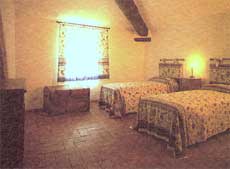 Over the past ten years or so we have slowly restored and converted some of the old farm workers houses and other farm buildings into guest apartments.
We've tried to keep the character of the houses, leaving exposed beams, the terra cotta floors and simple white washed walls. Most of the houses are named after the children in the family, some of whom
you'll meet during your stay: Massimo runs the farm, Damiano is the bookkeeper, and Marta does much of the administrative work in the office; Adriana is their mother. Luisa and Virginia are the other Donati
daughters. I myself have been here nearly ten years, running and developing the agriturismo business. Originally I came for four months but was captured by Tuscany's magical web!
Over the past ten years or so we have slowly restored and converted some of the old farm workers houses and other farm buildings into guest apartments.
We've tried to keep the character of the houses, leaving exposed beams, the terra cotta floors and simple white washed walls. Most of the houses are named after the children in the family, some of whom
you'll meet during your stay: Massimo runs the farm, Damiano is the bookkeeper, and Marta does much of the administrative work in the office; Adriana is their mother. Luisa and Virginia are the other Donati
daughters. I myself have been here nearly ten years, running and developing the agriturismo business. Originally I came for four months but was captured by Tuscany's magical web!
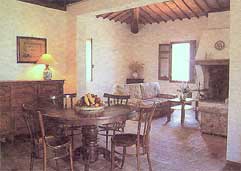 Each house at Montestigliano is different and has its own charm. Casa Massimo was a barn where Vin Santo was made, and attached to it was the
dovecote that is now the kitchen. Adriana was the former kitchen and cantina of the 'big' house. Marta was converted in the 1960's by 'Nonno' (Grandfather) Donati for the grandchildren to stay in. Casa
Virginia was originally a workshop that was converted at the beginning of this century to a farm dwelling. Casa Luisa, Damiano and Repoli were all houses where the farm hands used to live. In fact
two brothers who still work here were born in Casa Ropoli and have quite a few stories to tell!
Each house at Montestigliano is different and has its own charm. Casa Massimo was a barn where Vin Santo was made, and attached to it was the
dovecote that is now the kitchen. Adriana was the former kitchen and cantina of the 'big' house. Marta was converted in the 1960's by 'Nonno' (Grandfather) Donati for the grandchildren to stay in. Casa
Virginia was originally a workshop that was converted at the beginning of this century to a farm dwelling. Casa Luisa, Damiano and Repoli were all houses where the farm hands used to live. In fact
two brothers who still work here were born in Casa Ropoli and have quite a few stories to tell!
 Needless to say, we loved Montestigliano. It was an experience well worth the time and expense. The group got along well and everyone took their own
fair share of chores. Still, no one was pressured to take part in any activity, yet everyone was welcome. It was a great trip!
Needless to say, we loved Montestigliano. It was an experience well worth the time and expense. The group got along well and everyone took their own
fair share of chores. Still, no one was pressured to take part in any activity, yet everyone was welcome. It was a great trip!
|





|
|
 |